


Murano glass as an investment – uniqueness pays off
In economically uncertain times, art is considered a valuable investment with long-term potential for significant appreciation. Peter Grünbaum, a long-time collector and dealer of objects made from this unique material, knows whether this also applies to Murano glass.
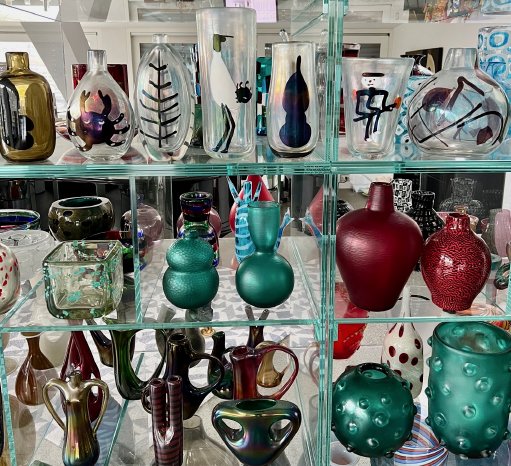
Venice is considered the cradle of Central European glassmaking. The offshore island of Murano owes its continued position as the home of some of the world's most important glass artists, as well as the namesake of the world's most well-known material for vases and other glass objects, to fire safety. At the end of the 13th century, all glass furnaces were relocated to the island to eliminate the threat to the growing population of the regional capital. In the centuries that followed, Murano became synonymous with unique expertise and artistry in handling this versatile material. Objects made of Murano glass remain unmistakable to this day for connoisseurs and collectors and, due to their quality, purity and structure, stability, and characteristics such as brilliance and transparency of the colors, are literally objects of insatiable desire.
As with other objects in art history, Murano glass's uniqueness and popularity give rise to another perspective that influences demand: its value development. Simply put, something beautiful, exclusive, and rare often also has potential as an investment – both in terms of maintaining its value and increasing its value. Peter Grünbaum, a passionate collector since his early youth with a wide range of preferences for beautiful and rare objects, and a passion for glass and design for 30 years, explains whether and under what conditions a Murano glass object has the potential to be a valuable investment. Although more than 4,000 glass rarities, as well as design and lighting objects, have found new owners through his hands in the meantime, his collection today still comprises around 6,000 objects, including a wide variety of Murano glass objects by various artists from different eras, as well as lighting, porcelain, and ceramics.
Mr. Grünbaum, do you collect Murano glass yourself as an investment?
First and foremost, I am a collector, not a speculator. Many of the items I have collected over the course of my collecting career are primarily of value to other collectors or only gain significance as part of a comprehensive collection. In the 1980s, for example, I sold one of the largest collections of toy robots I had assembled in two decades, comprising 1,200 individual pieces, to the Vitra Museum in Weil am Rhein. It had little to do with investment or returns, but it fetched a good price at the time. To this day, when I buy and sell objects, I'm primarily driven by my passion for collecting and the joy of beautiful and rare things.
But is Murano glass a sensible investment?
There's no simple "yes" or "no" answer to that. I currently own more than 2,000 glass objects, and by no means would I describe all of them as economically attractive purchases. In fact, when I first began exploring glass objects, I was dazzled by my initial fascination and bought many pieces that I will probably never be able to sell. But that doesn't mean that Murano glass isn't a fundamentally worthwhile purchase, some of which have impressive return potential. The sums that have been achieved for individual pieces at auctions in recent years alone are proof of this. The record, for example, is held by Thomas Stearns' "La Sentinella di Venezia," a 56 cm high blown glass object from 1962. Estimated at $300,000 to $500,000, it fetched an impressive $737,000 at the Wright auction house in Chicago in 2018. Other pieces from the 1940s and 1950s, such as the bowl bearing the name Tomaso Buzzi (1900-1981), "Coppa delle Mani", 1932, model no. 3416, had an issue price of 500 euros and, around 60 years later, fetched a proud 300,000 euros at Christie's. That's an increase in value of the equivalent of ten percent per year. In contrast, however, there are models from my current selection that also fetched several hundred thousand euros in 2008, but which I am offering today for a tenth of that. So, what do you recommend to anyone interested? Buy Murano glass! That would be my recommendation. Enjoy the unique beauty of the objects. Perhaps your first object will be the beginning of a great passion for collecting, who knows? When buying, make sure that you don't just like an object personally; its actual value must also be in line with the price. It's therefore advisable to familiarize yourself in detail with Murano glass beforehand, to familiarize yourself with the different eras and artists, and to be able to estimate the current, realistic value of a piece. Therefore, above all, you should trust the seller and be able to recognize their expertise and reliability. This is the only way to protect yourself from making bad purchases and, unfortunately, from the numerous counterfeits currently in circulation. Check out my e-book, which you can download free of charge. For this reason, I attach great importance to ensuring the complete tracing of the origins of the objects I offer. Many of them come from family collections that have been cultivated over several generations. To fully protect my customers, I also offer a right of return.
As an investment, a longer-term perspective is especially advisable. Don't count on a surprise find that will make you rich overnight. Such "flea market finds" are rather unrealistic in the internet age, as sellers know very well what an object is currently worth. Nevertheless, you can expect a long-term increase in value for sought-after objects by great glass artists such as Carlo Scarpa, Fulvio Bianconi, Paolo Venini, Tomaso Buzzi, Napoleone Martinuzzi, Thomas Stearns, Yoichi Ohira, Dino Martens, and Barovier & Toso, if you find them for sale from a reputable source. As with all valuable rarities, however, the law of supply and demand applies here too, which hardly allows for reliable forecasts. This is especially true given that there has been hardly any first-class Murano glass available since the late 1960s, and production is now on the verge of extinction.
E-book
Rare Murano Glass
Book an Appointment
Videos about Murano Glass
As with other objects in art history, Murano glass's uniqueness and popularity give rise to another perspective that influences demand: its value development. Simply put, something beautiful, exclusive, and rare often also has potential as an investment – both in terms of maintaining its value and increasing its value. Peter Grünbaum, a passionate collector since his early youth with a wide range of preferences for beautiful and rare objects, and a passion for glass and design for 30 years, explains whether and under what conditions a Murano glass object has the potential to be a valuable investment. Although more than 4,000 glass rarities, as well as design and lighting objects, have found new owners through his hands in the meantime, his collection today still comprises around 6,000 objects, including a wide variety of Murano glass objects by various artists from different eras, as well as lighting, porcelain, and ceramics.
Mr. Grünbaum, do you collect Murano glass yourself as an investment?
First and foremost, I am a collector, not a speculator. Many of the items I have collected over the course of my collecting career are primarily of value to other collectors or only gain significance as part of a comprehensive collection. In the 1980s, for example, I sold one of the largest collections of toy robots I had assembled in two decades, comprising 1,200 individual pieces, to the Vitra Museum in Weil am Rhein. It had little to do with investment or returns, but it fetched a good price at the time. To this day, when I buy and sell objects, I'm primarily driven by my passion for collecting and the joy of beautiful and rare things.
But is Murano glass a sensible investment?
There's no simple "yes" or "no" answer to that. I currently own more than 2,000 glass objects, and by no means would I describe all of them as economically attractive purchases. In fact, when I first began exploring glass objects, I was dazzled by my initial fascination and bought many pieces that I will probably never be able to sell. But that doesn't mean that Murano glass isn't a fundamentally worthwhile purchase, some of which have impressive return potential. The sums that have been achieved for individual pieces at auctions in recent years alone are proof of this. The record, for example, is held by Thomas Stearns' "La Sentinella di Venezia," a 56 cm high blown glass object from 1962. Estimated at $300,000 to $500,000, it fetched an impressive $737,000 at the Wright auction house in Chicago in 2018. Other pieces from the 1940s and 1950s, such as the bowl bearing the name Tomaso Buzzi (1900-1981), "Coppa delle Mani", 1932, model no. 3416, had an issue price of 500 euros and, around 60 years later, fetched a proud 300,000 euros at Christie's. That's an increase in value of the equivalent of ten percent per year. In contrast, however, there are models from my current selection that also fetched several hundred thousand euros in 2008, but which I am offering today for a tenth of that. So, what do you recommend to anyone interested? Buy Murano glass! That would be my recommendation. Enjoy the unique beauty of the objects. Perhaps your first object will be the beginning of a great passion for collecting, who knows? When buying, make sure that you don't just like an object personally; its actual value must also be in line with the price. It's therefore advisable to familiarize yourself in detail with Murano glass beforehand, to familiarize yourself with the different eras and artists, and to be able to estimate the current, realistic value of a piece. Therefore, above all, you should trust the seller and be able to recognize their expertise and reliability. This is the only way to protect yourself from making bad purchases and, unfortunately, from the numerous counterfeits currently in circulation. Check out my e-book, which you can download free of charge. For this reason, I attach great importance to ensuring the complete tracing of the origins of the objects I offer. Many of them come from family collections that have been cultivated over several generations. To fully protect my customers, I also offer a right of return.
As an investment, a longer-term perspective is especially advisable. Don't count on a surprise find that will make you rich overnight. Such "flea market finds" are rather unrealistic in the internet age, as sellers know very well what an object is currently worth. Nevertheless, you can expect a long-term increase in value for sought-after objects by great glass artists such as Carlo Scarpa, Fulvio Bianconi, Paolo Venini, Tomaso Buzzi, Napoleone Martinuzzi, Thomas Stearns, Yoichi Ohira, Dino Martens, and Barovier & Toso, if you find them for sale from a reputable source. As with all valuable rarities, however, the law of supply and demand applies here too, which hardly allows for reliable forecasts. This is especially true given that there has been hardly any first-class Murano glass available since the late 1960s, and production is now on the verge of extinction.
E-book
Rare Murano Glass
Book an Appointment
Videos about Murano Glass
