


Murano glass vases by Thomas Stearns: A “strange bird” leaves traces
During his time at the Venini glassworks, the ideas of the American artist Thomas Stearns were not only met with approval.
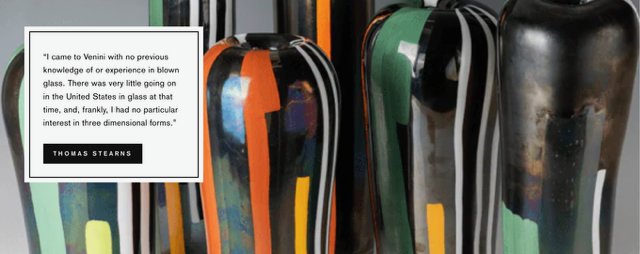
During his time at the Venini glassworks, the ideas of the American artist Thomas Stearns were not always well received. Nevertheless, glass works from this period are today considered rare treasures that have influenced the history of the craft.
Foreign artists, including those from the United States, were employed as designers by the renowned Venini glassworks even before the American Thomas Stearns. Yet few are as memorable as Stearns, who took his first steps with three-dimensional objects at Venini in the early 1960s, in the world of Murano glass of all places. His unconventional approach did not immediately generate enthusiasm.
The very first designs and models that Stearns presented to master glassblower Arturo Biasutto "Boboli" were met with strong rejection due to their significant differences from the usual standards. The main reason for this was Stearns' deviation from the symmetry typical of Venini. Stearns was therefore quickly perceived as a troublemaker whose ideas, lack of language skills, and perceived lack of understanding of Murano glass as such were not welcome. It was only through the initiative of the youngest master glassblower at Venini, a student of Boboli, Francesco "Checco" Ongaro, that Thomas Stearns was given the opportunity to implement his ideas.
Stearns remained somewhat of an outsider at Venini even in the years that followed. Nevertheless, he learned how to work with Murano glass, although he still did not use it in the classic style. Instead, he combined the traditional material and techniques with motifs from Abstract Expressionism, which was emerging in the USA, and created impressive pieces to this day, including those using the "Incalmo" technique. Despite recurring disagreements, several pieces from his collaboration with "Checco" Ongaro have survived and achieved impressive results at auctions in the past. For example, Stearns' three-part conceptual sculpture "La Sentinella di Venezia" (The Guardian of Venice) from 1962 was auctioned for $737,000 in 1982.
In addition to the results of his work at Venini, Stearns's working methods also had a significant influence on the further development of the previously strictly traditional division of roles. With his habit of accompanying the work at the kiln, Stearns changed the relationship and dynamic between design and craftsmanship, thus creating conditions from which his successors, some of whom were also American artists, also benefited.
Some famous objects from Stearns's work can be found today in the "1000 Objects" collection, one of the world's largest collections of glass and design, owned by the Swiss artist Peter Grünbaum. These include unique examples of the then revolutionary work from the "Facciate di venezia" (Facade of Venice) series, a series of 10 objects that, according to Stearns himself, had "a special meaning" (Thomas Stearns, 2002). A total of nine objects by Thomas Stearns
are currently for sale in the collection's online shop . The passionate collector and Murano glass enthusiast Peter Grünbaum will be happy to answer any questions you may have about these and all other objects in the unique collection.
Detailed information can be found here:
www.1000-objekte.ch (@petergruenbaum) • Instagram photos and videos
1000 objekte | Zurich | Facebook
Event – 1000 Objects (1000-objekte.ch)
Murano Glass Collector's Item – 1000 Objects (1000-objekte.ch)
Foreign artists, including those from the United States, were employed as designers by the renowned Venini glassworks even before the American Thomas Stearns. Yet few are as memorable as Stearns, who took his first steps with three-dimensional objects at Venini in the early 1960s, in the world of Murano glass of all places. His unconventional approach did not immediately generate enthusiasm.
The very first designs and models that Stearns presented to master glassblower Arturo Biasutto "Boboli" were met with strong rejection due to their significant differences from the usual standards. The main reason for this was Stearns' deviation from the symmetry typical of Venini. Stearns was therefore quickly perceived as a troublemaker whose ideas, lack of language skills, and perceived lack of understanding of Murano glass as such were not welcome. It was only through the initiative of the youngest master glassblower at Venini, a student of Boboli, Francesco "Checco" Ongaro, that Thomas Stearns was given the opportunity to implement his ideas.
Stearns remained somewhat of an outsider at Venini even in the years that followed. Nevertheless, he learned how to work with Murano glass, although he still did not use it in the classic style. Instead, he combined the traditional material and techniques with motifs from Abstract Expressionism, which was emerging in the USA, and created impressive pieces to this day, including those using the "Incalmo" technique. Despite recurring disagreements, several pieces from his collaboration with "Checco" Ongaro have survived and achieved impressive results at auctions in the past. For example, Stearns' three-part conceptual sculpture "La Sentinella di Venezia" (The Guardian of Venice) from 1962 was auctioned for $737,000 in 1982.
In addition to the results of his work at Venini, Stearns's working methods also had a significant influence on the further development of the previously strictly traditional division of roles. With his habit of accompanying the work at the kiln, Stearns changed the relationship and dynamic between design and craftsmanship, thus creating conditions from which his successors, some of whom were also American artists, also benefited.
Some famous objects from Stearns's work can be found today in the "1000 Objects" collection, one of the world's largest collections of glass and design, owned by the Swiss artist Peter Grünbaum. These include unique examples of the then revolutionary work from the "Facciate di venezia" (Facade of Venice) series, a series of 10 objects that, according to Stearns himself, had "a special meaning" (Thomas Stearns, 2002). A total of nine objects by Thomas Stearns
are currently for sale in the collection's online shop . The passionate collector and Murano glass enthusiast Peter Grünbaum will be happy to answer any questions you may have about these and all other objects in the unique collection.
Detailed information can be found here:
www.1000-objekte.ch (@petergruenbaum) • Instagram photos and videos
1000 objekte | Zurich | Facebook
Event – 1000 Objects (1000-objekte.ch)
Murano Glass Collector's Item – 1000 Objects (1000-objekte.ch)
