


Murano glass objects at 1000 Objects – good origin reveals itself quickly
When it comes to glass art objects, Murano glass is the benchmark for glass enthusiasts. With his unique collection "1000 Objects," Peter Grünbaum offers highlights of this unique provenance as collector's items with attractive potential.
From a scientific point of view alone, glass is a more than fascinating material in itself. The “amorphous, mostly transparent solid, which is produced by melting and then rapidly cooling inorganic compounds such as silicon dioxide (quartz sand)” 1 seems to defy the laws of nature in a state that is neither typically solid nor typically liquid and is particularly impressive due to its transparency, to which glass owes its diverse applications. Applications that make glass an everyday companion today. More than 130 million tons of glass are therefore produced worldwide every year. Almost half of this enormous amount is further processed into container glass or used as flat glass, for example in the construction industry. Despite all its fascination, glass is now mostly a disposable product that has only not been completely replaced by alternative materials thanks to a recycling rate of around 73% across Europe.
Since the beginnings of glass production in the third millennium BC, Since the 1st century AD, glass has been of greatest interest, above all, to art. With its very specific properties and requirements for artistic processing, glass joins the ranks of materials favored by artisans such as wood, stone, or metal and surpasses them, at least in the eyes of glass art lovers, with its combination of transparency and versatility in color and shape, as well as the unique tension between immortality and fragile fragility.
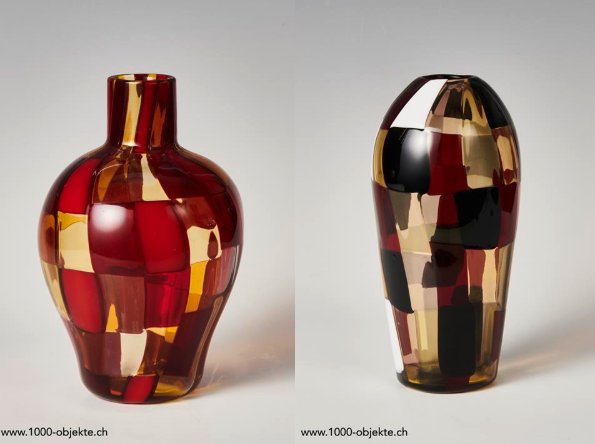
In the visual arts, it is above all the names of individual artists who represent a discipline. The classical sculptor Michelangelo Buonarotti, the sculptures of Richard Serra, figures and reliefs by Franz Abart – different eras were shaped by styles but especially by individual artists. Even if glass art is also associated with internationally renowned names, it is above all the provenance – the local origin – that inspires collectors, represents special quality, and, not least, determines the collector value of a glass object. The name of the small Venetian island of Murano represents more than seven centuries of glass art at the highest level. Since the Renaissance at the latest, Murano glass objects have conquered the world and to this day not only inspire die-hard collectors, but also captivate every viewer with their unique play of shapes and colors.
With some of these undeniably impressive prices – for example, in 2019, the Murano glass bowl "COPPA DELLE MANI" by Tomaso Buzzi from the 1930s fetched a record sum of approximately 300,000 euros at a Christie's auction – credible proof of provenance becomes even more important. In addition to characteristic features of genuine Murano glass, such as small air pockets, the typical color intensity and play of colors, gold or silver inlays, or even minor imperfections that make Murano glass objects so special, buyers are primarily concerned with the trustworthiness of the seller.
As a passionate collector, Swiss-born Peter Grünbaum has built a reputation over decades as an expert and trusted provider of Murano glass objects. His "1000 Objects" collection of Murano glass offers not only the astronomical price ranges described above, which have rarely been reached in recent years anyway, but also collector's items in a wide range of price categories. Peter Grünbaum's customers can always be confident that they are investing in genuine Murano glass, for whose provenance the "pathological collector" stands by his name.
The collector's online shop currently offers more than 200 vases and design objects made of Murano glass for reliable purchase. These include items for less than CHF 3,000, such as the sculpture "Amplesso" by the Italian artist Fulvio Bianconi from 1979, as well as some collector's items such as the rare and important mosaic vase "Mosaico" by Vetreria Artistica Barovier for CHF 120,000.
Further highlights of the collection include Toots Zynsky's colorful "Filet-de-verre" glass bowl, featuring a vibrant interplay of red, blue, yellow, and green from the Thierry Guerlain collection, and objects by Yoichi Ohira, also from this collection, which combine glass art and Zen in gentle color gradients.
As proof of provenance, Peter Grünbaum documents the previous owners of each object. These include, for the most part, renowned collections belonging to equally renowned personalities, such as Gian Battista Farina, the founder of the famous design house Pinin Farina, from whom Grünbaum personally received, for example, the Ercole Barovier murrine vase from 1930. A
large portion of the vases and objects offered in this way have been examined by international experts and found to be authentic. Furthermore, a generous return policy offers buyers additional security in their decision to purchase one of these unique objects.
Since the beginnings of glass production in the third millennium BC, Since the 1st century AD, glass has been of greatest interest, above all, to art. With its very specific properties and requirements for artistic processing, glass joins the ranks of materials favored by artisans such as wood, stone, or metal and surpasses them, at least in the eyes of glass art lovers, with its combination of transparency and versatility in color and shape, as well as the unique tension between immortality and fragile fragility.
In the visual arts, it is above all the names of individual artists who represent a discipline. The classical sculptor Michelangelo Buonarotti, the sculptures of Richard Serra, figures and reliefs by Franz Abart – different eras were shaped by styles but especially by individual artists. Even if glass art is also associated with internationally renowned names, it is above all the provenance – the local origin – that inspires collectors, represents special quality, and, not least, determines the collector value of a glass object. The name of the small Venetian island of Murano represents more than seven centuries of glass art at the highest level. Since the Renaissance at the latest, Murano glass objects have conquered the world and to this day not only inspire die-hard collectors, but also captivate every viewer with their unique play of shapes and colors.
With some of these undeniably impressive prices – for example, in 2019, the Murano glass bowl "COPPA DELLE MANI" by Tomaso Buzzi from the 1930s fetched a record sum of approximately 300,000 euros at a Christie's auction – credible proof of provenance becomes even more important. In addition to characteristic features of genuine Murano glass, such as small air pockets, the typical color intensity and play of colors, gold or silver inlays, or even minor imperfections that make Murano glass objects so special, buyers are primarily concerned with the trustworthiness of the seller.
As a passionate collector, Swiss-born Peter Grünbaum has built a reputation over decades as an expert and trusted provider of Murano glass objects. His "1000 Objects" collection of Murano glass offers not only the astronomical price ranges described above, which have rarely been reached in recent years anyway, but also collector's items in a wide range of price categories. Peter Grünbaum's customers can always be confident that they are investing in genuine Murano glass, for whose provenance the "pathological collector" stands by his name.
The collector's online shop currently offers more than 200 vases and design objects made of Murano glass for reliable purchase. These include items for less than CHF 3,000, such as the sculpture "Amplesso" by the Italian artist Fulvio Bianconi from 1979, as well as some collector's items such as the rare and important mosaic vase "Mosaico" by Vetreria Artistica Barovier for CHF 120,000.
Further highlights of the collection include Toots Zynsky's colorful "Filet-de-verre" glass bowl, featuring a vibrant interplay of red, blue, yellow, and green from the Thierry Guerlain collection, and objects by Yoichi Ohira, also from this collection, which combine glass art and Zen in gentle color gradients.
As proof of provenance, Peter Grünbaum documents the previous owners of each object. These include, for the most part, renowned collections belonging to equally renowned personalities, such as Gian Battista Farina, the founder of the famous design house Pinin Farina, from whom Grünbaum personally received, for example, the Ercole Barovier murrine vase from 1930. A
large portion of the vases and objects offered in this way have been examined by international experts and found to be authentic. Furthermore, a generous return policy offers buyers additional security in their decision to purchase one of these unique objects.
